Showing posts with label Christianity. Show all posts

Thursday, November 15, 2007

Going through the Grits

I have a theory.   Given enough time, patience, and sandpaper, a person can fell a full-grown oak tree.   I'm reasonably confident of this hypothesis. After all, wind and water can shape rock over time.   I'd say the chances are infinitely better than that of an infinite number of monkeys with typewriters completing the works of William Shakespeare.

But even if it is possible, why would you do it?   It would be a silly use of your time and resources.   Even I know that if you want to cut down a large tree, you need a large saw with large sharp teeth – preferably powered by something other than muscle.

A carpenter chooses the tools he needs to shape the wood into a beautiful, useful item.   One saw for cutting the tree, another for ripping boards.   A lathe for turning legs, a fine tool for carving designs.   Occasionally, a woodworker will shape wood by exposing it to boiling water or steam and pressing or stretching it over a form.

When the item has been built, the carpenter will want to give it a beautiful finish.   Now is the time to reach for that sandpaper.   Woodworkers talk about "going through the grits."   Sadly, this has nothing to do with devouring Southern corn porridge seasoned with salt, pepper, butter, and maybe a bit of cheese.   To a woodworker, going through the grits means to move progressively from coarse to fine sandpaper to remove blemishes and leave a smooth finish.   As tempting as it might be to skip a few grades, this may not produce the best results.

We are a lot like the oak.   Adversity may cut and scrape and pound and expose us to great heat and pressure.   Pain and loss and tears and grief are some of the tools that shape our lives into things of beauty and purpose.   The apostle Paul put it this way in Romans 5:3-4:
…we also rejoice in our sufferings, because we know that suffering produces perseverance; perseverance, character; and character, hope.
If we follow Paul's advice, if we will offer a sacrifice of Thanksgiving through pain and adversity, adversity can transform us.   Helen Keller believed:
Character cannot be developed in ease and quiet.  Only through experience of trial and suffering can the soul be strengthened, ambition inspired, and success achieved.

There are no shortcuts – we can't bypass the saws for the sandpaper.   Trials can give us perspective, produce humility, drive us to a reliance on God, create hearts sensitive to the needs of others, teach patience, strengthen our character, and increase our appreciation for our blessings – but only if we embrace the lessons they teach.   Swiss writer/philosopher Henri-Frédéric Amiel once wrote,
You desire to know the art of living, my friend? It is contained in one phrase: make use of suffering.
  We'll explore how we might make use of our suffering next.

Monday, November 12, 2007

GMC

Before I joined TARA, if you had asked me about my GMC, I would have described the pick-up truck my dad drove during the '70s.

But when a writer refers to the GMC, she is referring to Goal, Motivation and Conflict as described in the classic book by Debra Dixon.   The GMC drives the plot.   (Pun intended.)   It can be defined as follows:

Goal – what the character wants
Motivation – why the character wants it
Conflict – why the character can't have it

I've been contemplating whether or not I could apply the GMC model to real life.   We all have goals.   Simple goals.  Complex goals.   External goals and internal goals.   Whether it is to fix the kids a healthy lunch, lose weight, or get to work on time, we have hundreds of goals every single day.

We all have motivations behind these goals as well.   We want to fix the kids a healthy lunch because we love them.   We want to lose weight because that 25th reunion is around the corner.   We want to get to work on time because we value our jobs.

So far, so good.   Now we come to conflict.   We know we have plenty of that!   I want to fix the kids a healthy lunch because I love them, but the dog snagged the loaf of whole wheat bread from the counter and ate it.   I want to lose weight in order to look good for that reunion, but Thanksgiving and Christmas arrive first – with all that tempting food.   I want to get to work on time because I value my job, but I picked up a nail in my tire and have a flat.   Sometimes the conflict is a consequence of our action or inaction, other times it arises from sources beyond our control.   But wherever it comes from, we have it to spare!

The difference between an author's GMC and real life is that in real life, we do not want conflict.   We do everything we can to avoid it.   We pray to be delivered from it.

An author, on the other hand, creates characters she loves, then tortures them for your reading pleasure.   There are a few important reasons an author persecutes her characters.

Without conflict, a story is boring.   Imagine a 400-page novelization of Teletubbies or the Wiggles.   No, even those shows have conflict of the mildest sort.   Four hundred pages of dialogue from a Wal-Mart greeter?

Conflict helps readers connect with the characters in a story.   If you are divorced, you may relate to a character who is looking for love after a divorce.   If you are fighting cancer, you may understand a character who struggles with the disease.   If you are an archaeologist with an expertise in medieval weaponry who is chasing a serial killer who murders his victims in bizarre ways, you've been reading Karen Rose's Die for Me too long.   Put the book down and step away.   (Sorry.   I couldn't resist.)

Conflict also helps an author reveal a character's moral fiber.   How do I show that the heroine is strong if she never struggles?   How can you learn that a hero is faithful if he is never tempted?   How will we know a character is courageous if he never faces difficult circumstances?

Author Julie Leto writes "tough-cookie heroines" -- so tough, she needs some serious conflict to reveal any weaknesses.   "One of the only ways I can make my heroines vulnerable is to have them nearly electrocuted and put in the hospital."

An author has great reasons to inject lots and lots of conflict into stories, but do we need adversity in real life?   A boring life doesn't sound so bad to me.   It reminds me of the supposed ancient Chinese curse, "May you live in interesting times."

Does adversity help us connect with others?   Look at the proliferation of support groups for your answer.   We all suffer in various ways, and no one understands our pain like someone who has been through it.

After my ectopic pregnancy, I went through a period of serious depression.   My concerned husband called my OB/GYN, who referred us to a pregnancy and infant loss support group at our local hospital.   The group was led by a couple who had experienced two miscarriages.   We found tremendous healing in that group and became good friends with this couple.   Later on, our experiences in infertility led us to help start an infertility support group in our community.

Experiencing infertility and losing a pregnancy made us more sensitive to others in the same situation.   We were helped by a couple who suffered before us, and in turn, we were able to help others in need.   In hindsight, I can see purpose in the pain we faced when we lost our first baby.

Adversity definitely tests and reveals our moral fiber.   It can also reveal the character and nature of God.   In John 9:1-3, we read:

As he went along, he saw a man blind from birth. His disciples asked him, "Rabbi, who sinned, this man or his parents, that he was born blind?"

"Neither this man nor his parents sinned," said Jesus, "but this happened so that the work of God might be displayed in his life."

Jesus went on to give the blind man his sight.

I don't want to carry this analogy too far.   I don't want to cast the Creator as some Cosmic Stephen King, merrily inflicting terror and disaster on His creations for His own entertainment.   I only want to illustrate that pain may have a purpose – to help us to relate to those in need, to test and reveal our own strengths and weaknesses, and to reveal the character of God.   Does pain serve any other purpose?   We'll continue exploring that soon.

Pain with a Purpose

In 1988, my husband and I attended natural childbirth classes in anticipation of the arrival of our firstborn child.   I remember one of the films we watched described labor as "pain with a purpose."

Although I resented the statements that described labor pains as "discomfort" or "tightening" instead of mind-searing, gut-wrenching agony – I did appreciate the concept of pain with a purpose.   We marched into the labor room armed with a wedding photo as a focal point and tapes full of soothing music like Pachelbel's Canon in D Major and Handel's Water Music.   Hours and hours later, our son Christopher was born.   The concept of pain with a purpose helped me handle a difficult labor, and unlike Alex in A Clockwork Orange, I still enjoy classical music without experiencing physical pain.

Labor was the most intense physical pain I've ever experienced, but it wasn't the worst pain I have experienced.   The worst pain came a year earlier, when I lost our first baby in an ectopic pregnancy.

We had suffered through infertility treatments for 18 months before I had the joy of finding two faint blue lines on the home pregnancy test.   I was ecstatic.   Everything looked sharper.   Colors appeared brighter.   The world held great promise – for five glorious days.

That's when I started spotting.   Then the pain began.   Five days, two trips to the emergency room, two ultrasounds, and a hospital stay later, the doctors told me I was probably miscarrying and sent me home.   The following day, I ruptured.   The pain was excruciating, right up until the time I passed out.   I was in surgery for two and a half hours.   In recovery, while I was still out of my head from the anesthesia, my husband recalls I chanted over and over "It hurts. It hurts. It hurts."

But what really hurt was that, on top of all the physical pain, we had lost our baby, and I had lost a fallopian tube.   The chances of ever having another child were reduced, and I was desolate.   All that pain had no purpose, or at least no good purpose that I could discern.

A friend recently reminded me of the story of Joseph (the one with the Technicolor Dreamcoat).   You can read the story in the book of Genesis, Chapters 37, and 39-48.   Joseph's envious brothers sold him into slavery.   Once in Egypt, his master Potiphar's wife falsely accused Joseph of attacking her.   Potiphar cast Joseph into prison.

I can't imagine the pain of that betrayal by his own brothers or the fear that prison brought.   Personally, I would have been bitterly angry and would have railed against the injustice.   But Joseph was confident that God had a purpose for everything that happened, and he patiently continued to serve God in whatever way he could.

Joseph's faith was rewarded.   God used Joseph to interpret Pharoah's dreams.   Because of Joseph, the nation of Egypt was saved from famine – as was the nation of Israel.   When Joseph revealed his identity to his brothers, they were afraid.   But Joseph told them:

And now, do not be distressed and do not be angry with yourselves for selling me here, because it was to save lives that God sent me ahead of you.   For two years now there has been famine in the land, and for the next five years there will not be plowing and reaping.   But God sent me ahead of you to preserve for you a remnant on earth and to save your lives by a great deliverance.   Genesis 45:5-7.

God eventually revealed His purpose to Joseph, but before he knew God's intent, Joseph trusted that the Lord had a purpose for his difficulties.   It is easier to handle pain, to give thanks through adversity, if you know there is a purpose.   Most of us don't have the luxury of knowing that our pain has a purpose.   Or do we?   Let's explore that next.

Sunday, November 11, 2007

The Sacrifice of Thanksgiving

Thanksgiving.   The word brings to mind many things to a 21st century American.   Pilgrims at Plymouth Rock.   Myles Standish and Massasoit.   Family gatherings.   Football.   And of course, an abundance of food.   For me, that food always includes roast turkey, cranberry sauce, my father's cornbread and sage dressing, my mother's fruit salad, and pumpkin pie.


But the tradition of a thanksgiving meal goes back thousands of years before the Mayflower.   Back in the days of Leviticus, one of the sacrifices offered was the Sacrifice of Thanksgiving.   The thanksgiving sacrifice was a peace offering given to thank God for His grace and to restore a right relation between God and man – a relationship broken by man's sin.   According to JewishEncyclopedia.com, peace offerings were usually private offerings.   A family would present oxen, sheep or goats to be sacrificed.   The sacrifice was followed by a joyous sacrificial meal.


Today, we don't thank God by sacrificing oxen, sheep, goats, or even turkeys.   In fact, sacrifice does not seem to be a word that goes well with the traditions of an American Thanksgiving.   Sacrifice involves the destruction, surrender or loss of something as an offering to God.   Thanksgiving is not about sacrifice but indulgence – isn't it?


Even though our Thanksgiving traditions focus on celebration and even indulgence, the act of giving thanks can be a sacrifice.   Sometimes it is difficult to see and give thanks for our blessings when life seems full of uncertainty, pain, or grief.   Some of my family members, friends and acquaintances face some difficult times this holiday season.   I'm thinking of:

  • a woman spending her first Thanksgiving since her divorce
  • a boy who lost his beloved pet dog
  • a woman with breast cancer recovering from surgery
  • a woman confronting a life of pain with no relief in sight
  • a woman facing a hysterectomy and unemployment
  • siblings and parents who are estranged
  • a man struggling with drug and alcohol addictions
  • a woman striving to keep her family warm this winter.
  • a single mother fighting for child support for her daughter
  • a family who lost many possesions in a fire
  • a couple spending the holidays separated from their young son
  • spouses and parents serving in the military separated from their loved ones.

    What do we destroy, surrender, or lose in offering to God when we give thanks through difficulties?   Perhaps we destroy the idea that our present pain is significant in light of God's eternal purpose.   We surrender fear, loneliness, despair, longing, bitterness, and regret.   We lose the right to nurse our grief or grievances.   We surrender ourselves to joy and hope.


    With Thanksgiving around the corner, I am going to explore the meaning of thanksgiving over the next few days.   I hope you'll join in the journey.

  • Love Songs

    Romantic that I am, I love a good love story and a good love song.   The ultimate love story is one of a perfect love thwarted by separation, betrayal, or brokenness, redeemed by some great act of courage or sacrifice, culminating in reunion, restoration, and the obligatory happily ever after.

    In that light, here are some of my favorite love songs.

    This Fragile Breath – Todd Agnew
    Grace Like Rain

    I searched the world for a song that I could sing,
    Praise to my King, a gift that I could bring.
    But no music I found could compare to You
    Not one could do justice to Your glory.
    What are my songs compared to Yours?

    Chorus:
    You speak with thunder and lightning
    Your voice shakes the mountains
    The foundations of the earth.
    All I can offer is this fragile breath,
    With each one I'll praise You
    With each one I'll praise You more.

    I searched the world for a poem I could read,
    A rhyme that would bring glory to my King.
    But no writing I found was worthy of
    This God high above all other gods.
    What are my words compared to Yours?

    Chorus

    Speak to me, speak to me please.
    Won't You speak to me?

    Chorus

    Look at Me – The Waiting
    Blue Belly Sky

    Golden bars of sunlight come sneaking through the shutters
    Laying stripes on my back like a zebra.
    Sweaty fingers turning pages, and clinging to the bed
    Like it's a bride and I never want to leave her.

    Paul calls me a saint and the mattress shakes with laughter
    And the sheets let out a chuckle while the pillow holds one in.
    I don't believe a word I read, but the man is so convincing
    Says You're calling me a winner of a game I never win.

    But with every word I read I feel Your eyes upon me
    And I don't mind at all.

    Chorus
    I love the way You look at me, the way You steer Your eyes
    To see the bride beneath the harlot's skin, the virtue underneath the sin.
    I love the way You look at me, when You lift the veil and You repeat Your vow.


    Get up for the shower, wash, and scrub, and scour every part
    As if a cleaner man could better bear the shame.
    Now, move out into the sunlight, a frightened fool
    There's reason for my fright, for I'm a messenger who's forgetting why he came.

    But with every step I take I feel Your eyes are on me,
    And I don't mind at all.


    For when You look at me, You see every drop of blood You spent.
    Like the color that comes creeping to my face.
    It is such sweet embarrassment to see the dowry that You paid for my cold embrace.
    But I'll never, never, never let You go because...

    Chorus

    Who Am I -- Casting Crowns
    Casting Crowns

    Who am I
    That the Lord of all the earth,
    Would care to know my name,
    Would care to feel my hurt?
    Who am I
    That the bright and morning star,
    Would choose to light the way,
    For my ever wandering heart?

    Bridge:
    Not because of who I am,
    But because of what You've done.
    Not because of what I've done,
    But because of who You are.

    Chorus:
    I am a flower quickly fading,
    Here today and gone tomorrow,
    A wave tossed in the ocean,
    A vapor in the wind.
    Still You hear me when I'm calling,
    Lord, You catch me when I'm falling,
    And You've told me who I am.
    I am Yours.
    I am Yours.

    Who am I
    That the eyes that see my sin
    Would look on me with love
    And watch me rise again?
    Who am I
    That the voice that calmed the sea,
    Would call out through the rain,
    And calm the storm in me?

    Not because of who I am,
    But because of what You've done.
    Not because of what I've done,
    But because of who You are.


    I am a flower quickly fading,
    Here today and gone tomorrow,
    A wave tossed in the ocean,
    A vapor in the wind.
    Still You hear me when I'm calling,
    Lord, You catch me when I'm falling,
    And You've told me who I am.
    I am Yours.

    Not because of who I am,
    But because of what You've done.
    Not because of what I've done,
    But because of who You are.


    I am a flower quickly fading,
    Here today and gone tomorrow,
    A wave tossed in the ocean,
    A vapor in the wind.
    Still You hear me when I'm calling,
    Lord, You catch me when I'm falling,
    And You've told me who I am.
    I am Yours.
    I am Yours.

    I am Yours.

    Whom shall I fear?
    Whom shall I fear?
    'Cause I am Yours.
    I am Yours.

    Thursday, April 13, 2006

    Cross Connections

    I was e-mailed a question today by a man named Hiredhand.   Strange name? Well, I “met” the gentleman in question on an Internet discussion board.  I have many “friends” there with names like Maximus of Texas and Peacebaby.  His question for me was, “What is God saying to you lately.”

    Not your everyday question.  Strangely enough, this same morning I received an e-mail from my friend Davlin.  Davlin isn’t his real name… it’s the name of his character on an MMORPG (Massive Multiplayer Online Role Playing Game) called City of Heroes.  Davlin, my husband and I (well, Area Man and Nuclear Mom), frequently discussed the meaning of life in between missions to defeat villains.  Davlin is a twenty-something young man living in rural Canada.  Of course, he could be a 13-year old boy from England, a 40-something inmate from California, or a 60-year old grandmother living down my block for all I really know.  Davlin doesn’t play City of Heroes any longer, but he occasionally writes to keep in touch.

    Keep in touch.  Reach out and touch someone.  Make connections.  

    My dearest friend recently expressed concern about her 13-year old daughter.  She’s a beautiful, sweet, talented and smart young lady – not the type to cause her mother concern.  But her mother has observed that when her daughter’s friendships become too challenging, her daughter is quick to sever ties.  I immediately thought of the Internet.  Our children are growing up in the age of e-mail, instant messaging, and MySpace.   Safety features allow us to screen our messages.  We can hide, lurk, global ignore.   If an internet conversation is getting too uncomfortable, we can easily walk away, change our handle, and block messages.

    So what is the connection between Hiredhand’s question, City of Heroes, and my friend’s daughter?   It’s coming – I promise.

    I just joined a small group at my church.  The groups are called Real Life Connections, and they seek to allow believers to grow more deeply in fellowship with one another.  The first week, we discussed love, how the word love is really defined by the actions of Jesus.  The second week, we discussed how to comfort those who mourn.  In John 11, the story of Lazarus, Jesus showed His love for His friends Lazarus, Martha and Mary by showing up, listening to Martha and Mary, weeping with them and praying for them – things we all should do to comfort others.  But then He did something we cannot do – He called Lazarus back from the dead, revealing the glory of God and His true nature to those who watched in amazement.   These acts of love set in motion the Pharisee’s plot to kill Jesus (John 11:53).   In John 15:12-13, Jesus says, This is My commandment, that you love one another, just as I have loved you.  Greater love has no one than this, that one lay down his life for his friends.

    We live in a world in which technology has made staying in touch with people so much easier, and yet we are as disconnected from one another as we have ever been.   In the days of Jane Austen, decorum kept conversations and relationships superficial, avoiding topics like religion or politics and staying with safe ones like the weather.  No such decorum exists today.  Strangers share their most intimate thoughts, desires, beliefs and actions with other strangers.  But relationships are no more intimate.  It’s cyber flashing.  We all walk around in trench coats looking for an audience, then FLASH!  We watch for reactions, and if they are favorable, we stay for more.  If not, we close our coats and find another audience.

    Cyber relationships are easy.  You don’t have to clean up your house, shower or change your clothes when your cyber friends come to visit.  If the conversation gets too dull, too heavy or too controversial, you walk away with little thought of your cyber friend or the real person behind the computer.   Real relationships are messy.  They take work.  They are risky.  Real relationships are costly.  We may be called to tear our robes, weep, sprinkle dust on our heads and be silent.  

    What is God saying to me lately?  This Holy Week, God is saying  Love others as I have loved you.  It’s a costly love, one that will require actions that far exceed my feelings at the moment.

    I am not advocating shunning all electronic relationships.   I don’t believe that desserts, for example, are so dangerous because of what they contain, but for what they replace.  If your diet consists of only desserts, you will miss the food that truly nourishes and sustains.  We are called to love others as Jesus loved us, and we can only do so much of that behind online masks.  Jesus shared meals with people, went to the markets where they shopped, the wells where they drew water, the shores where they fished, the temples where they prayed.  He met people in the places of their everyday lives and prayed for them, touched them, healed them, and taught them.  Christ connected with people and loved them, even unto death on the cross.

    Jesus is calling me to a leap of faith into the Holy Wild.  He’s calling me to trust Him and follow Him.  He’s asking me to be bold and courageous. He’s commanding me to love others as He loved, no matter what the cost.  He’s calling you, too, and, to borrow from my friend, Steve Brown, He asked me to remind you.

    Friday, January 27, 2006

    Inspired by End of the Spear

    Our family finally saw End of the Spear last night. Reviews for this production have varied widely, so if you aren’t completely confused, here is mine.

    End of the Spear is an independent film based on the true story of missionaries and their contact with a violent tribe in Ecuador. Many of the negative reviews seem to center on the story itself. Several reviewers appear to critique the film with an anti-religious, anti-missionary bias. They seem to want the movie to give what they consider an even-handed account of what missionary contact has done to indigenous peoples – even-handed meaning that the account paints missionary contact as misguided and/or evil.

    Desson Thomson in his Washington Post review wrote:

    Although the film invests time among the tribesmen, it never really explores the idea that one man's missionary work is another's ideological aggression.

    Allison Benedikt of the Chicago Tribune writes:

    That "End of the Spear" is a no-holds-barred Christian movie is not necessarily a bad thing, just something to consider when you're surfing Fandango.

    What is necessarily a bad thing is that "End of the Spear" is a childish and visually repetitive movie, ham-fisted, proselytizing and overtly simplified.

    Many of the critics seem upset with the story itself. They don’t want to hear a story about Christian missionaries going to an indigenous people and improving their lives. They don’t want to hear about Christians at all.

    The film is a relatively low budget, independent film. The production budget was $10 million dollars according to The Numbers . (King Kong had a production budget of $207 million.) The film did not feature famous actors, but the cast was large, and the production budget allowed for limited filming on location. I went in with high hopes but not high expectations for the quality of the film. I was pleasantly surprised. I thought the acting was decent, and the cinematography was often breathtaking.

    Far from being heavy-handed, this proselytizing movie never mentions the name of Jesus. Instead, God is referred to by His Waodani name. The missionaries’ spiritual lives, how they received their calls, and why they did what they did are virtually ignored. The focus of the production is the Waodanis. Nick Saint does tell his son that they would never kill the Waodanis, even in self-defense, because the Waodanis aren’t ready for Heaven, but the missionaries were. At one point, Dayumae, a Waodani who had been living with missionaries, explains that God has a Son who was speared, but did not spear back, so that those who spear can live a better life. The Waodanis are encouraged to follow God’s carvings on the trail. In two hours of film, that is the extent of the religious discussion that takes place. Christians may be disappointed by the lack of a clear presentation of the Gospel or any deep discussion of salvation.

    Unlike the documentary Beyond the Gates of Splendor, the Waodanis in the movie wear some clothes. Violence is depicted, but it is not extremely graphic in nature. Our nine-year old daughter loved the film, although she clung to her father’s arm through several parts. Some of the script is in Waodani with subtitles, but the story is less dependent on subtitles than was the documentary. The pacing was at times a bit slow. The filmmakers could have safely edited out 10-15 minutes and had a tighter film. Be sure to stay for the credits – you’ll see the real Steve Saint and Mincayane and some fun clips from the documentary.

    The film was “power released” in over 1,100 theaters and on its first weekend grossed $4.3 million. It needs to earn at least another $17.7 million to cover the production and advertising costs. According to the film's credits, half of any profit will go to help indigenous peoples like the Waodani.

    If any story was worth 2 hours of your time and $7.00 of your money, this is the one. Each member of our family – middle aged parents, teenage boys, and nine-year old girl – thought the movie was terrific. It’s not The Lord of the Rings or even The Passion of the Christ, but it is an inspiring true story of the power of God’s love and forgiveness to change hearts, minds, and even societies. Your time and money not only will buy you thought-provoking entertainment, but will also make a statement to Hollywood that the public wants uplifting, encouraging stories and will tell the critics that their opinions do not reflect the views of most of America. Now, that’s a bargain.

    Sunday, January 08, 2006

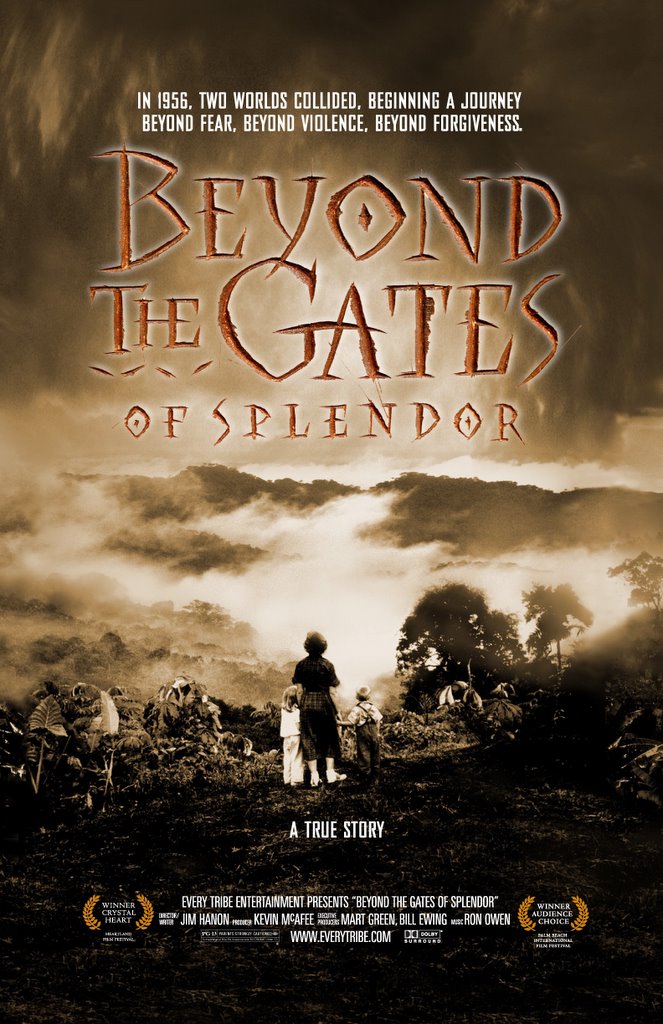
    Beyond Splendid


    The Auca society was the most violent ever documented. Six out of every ten deaths were due to homicide. In 1956, five American missionaries dared to make contact with this tribe of natives in Ecuador and found death at the end of a spear. The missionaries were armed when they were attacked, but they refused to use their weapons against the Aucas. The missionaries knew they were prepared for Heaven, but the Aucas were not.

    Beyond the Gates of Splendor documents the lives of these missionaries and their families. The stories are told by family members and members of the Waodani (formerly known as Auca) tribe. Theirs is an amazing, true tale of the power of love and forgiveness to transform lives.

    The documentary is extremely moving, so keep the tissues handy. But the tone is not grim, and there are several moments of laughter. The Waodanis did not wear clothing, and the documentary shows footage of village life. There are also black and white photos of the murdered missionaries. Some of the story is told in the Waodani language with subtitles. I wouldn’t recommend this for very young children, but our nine-year old daughter watched, laughed and cried with us.

    A theatrical version of this story, titled End of the Spear, will be released on January 20th. Both the documentary and the movie tell how God’s love transformed a society. Buy or rent the DVD of Beyond the Gates of Splendor, then join our family at the theater to enjoy End of the Spear. The summer blockbusters will include heroes like Superman and the X-Men. This winter, learn about real heroes, whose sacrifices impacted a whole society for eternity.

    Wednesday, December 28, 2005

    Forgotten Heritage of Faith

    I recently received an e-mail newsletter from the Evangelical Covenant Church featuring an interesting story about two foreign exchange students from Germany who found Christ while living with their host families.   http://www.covchurch.org/cov/news/item4664.html

    The story is wonderful, but the most surprising, frightening aspect was that one of the teenagers was completely ignorant of Germany’s Christian heritage.

    The girl had no understanding of the faith when she arrived, says Sparrman. "She was told in Germany that going to church was part of being an American. The Germans told her that it wasn't like it was in Germany - it was exciting."

    Her parents had grown up entirely under East German rule and no one in the family knew of the Germany's rich Christian history. "She had no clue about the Christian heritage of her country," Sparrman says. "No idea about Luther, no idea about Bonhoeffer."

    If a Christian heritage dating back to the eighth century can be completely erased from common knowledge in just over 50 years, how long would it take to obliterate a heritage only half as old?  How close is America to this same fate?  Will we Christians do it to ourselves in an effort to appear nonjudgmental and tolerant?  May it never be so.

    The Chronicles of Narnia: The Lion, the Witch and the Wardrobe

    When I learned that someone was making a film version of the C. S. Lewis classic, I was skeptical and a bit worried. Narnia is more than just a wonderful series of books -- it is the story of Creation, the Fall, the redemption of man and the redemption of creation. Could the film industry do the story justice?

    I was somewhat encouraged by the wonderful production of J.R.R. Tolkien’s The Lord of the Rings trilogy, another book series I did not believe could be filmed. Would Narnia, a series aimed at children, receive the same attention?

    I was pleasantly surprised to find that the movie version is delightful. The beginning, slow to some, was exactly as it should be… portraying what is was like to live in Britain in WWII. The child actors were wonderful. Although attractive, they were believable as ordinary school children – not extraordinarily brilliant or gifted. The battle scenes were virtually bloodless. But this is not The Lord of the Rings. A realistic battle scene would have eliminated much of the target audience – I cannot fault the production for the decision to keep the graphic violence to a minimum.

    The film is beautiful and quite faithful to the book. To the nonbeliever, it is an enchanting fantasy and good, wholesome entertainment. For the believer, though, when Aslan first enters the scene, well, the effect was very moving. Several Christians, myself included, said they actually shivered when Aslan appeared.

    If a cinematic lion, meant to depict Christ, engenders such a reaction, imagine the thrill, the joy, the unspeakable reaction when we see Him face to face!